
Volusia County Criminal Court Cases
Criminal jurisdiction in Volusia County is divided by both case level and geography. The Circuit Court of the Seventh Judicial Circuit hears felonies. Volusia County Court hears misdemeanors and criminal traffic matters. The offense location and assignment determine which clerk counter holds the working file, so the courthouse printed on a notice matters more than the requester's home address.
Four criminal service points form the local network. Circuit felony records on the west side are handled at the Volusia County Courthouse in DeLand, while east-side felony matters use the S. James Foxman Justice Center in Daytona Beach. County misdemeanor service is split between the DeLand courthouse and the Steven C. Henderson Judicial Center in Daytona Beach. Deltona, Daytona Beach, and Port Orange do not operate municipal criminal courts. City code boards are not substitutes for the county criminal docket.
Volusia Criminal Events Management
The official Criminal Events Management search is the free first stop for Volusia County criminal court cases. A user must accept the clerk's disclaimer before searching. Online entries are informational and are not the official court record. Name searches can produce false matches, and a missing document image can reflect access limits rather than an empty file.
The clerk's own search screen is shown below. It helps confirm the exact controls before entering a name or case number.
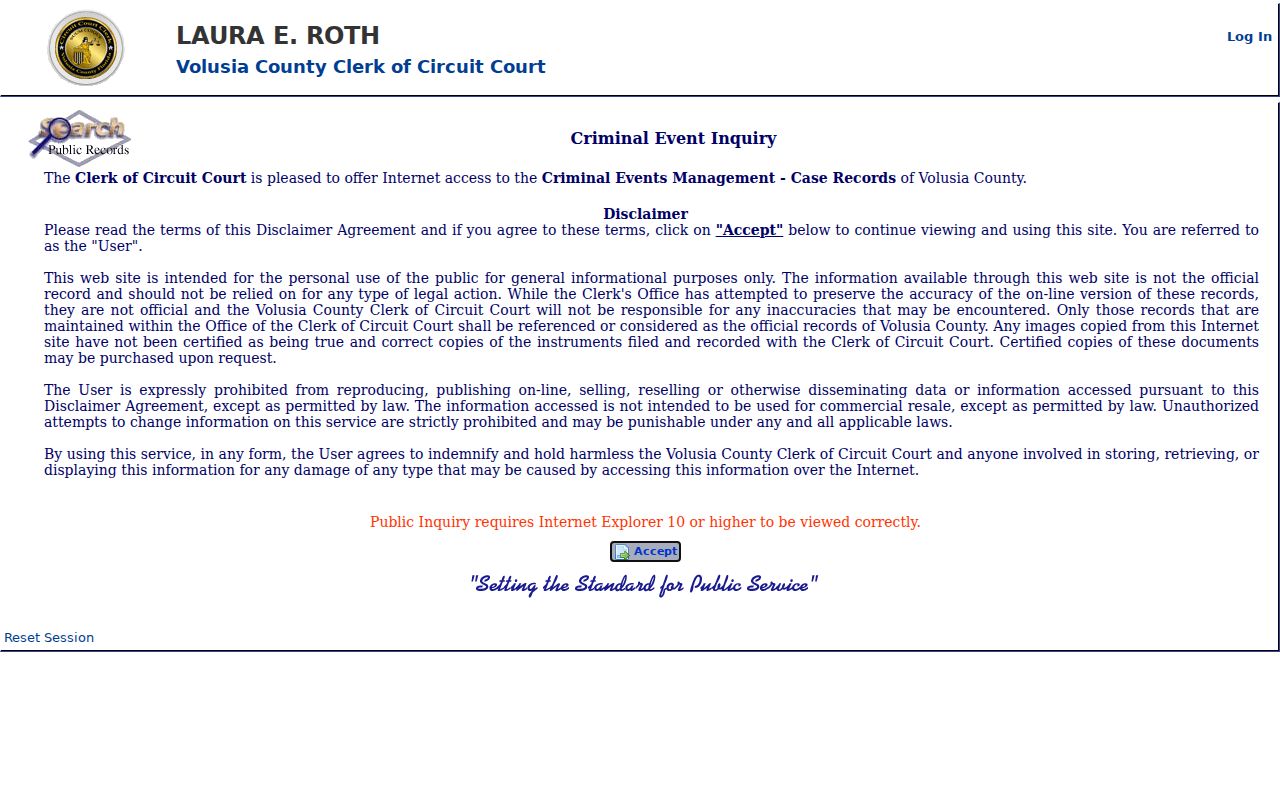
After locating a plausible match, compare the case number, birth year where displayed, charge, filing date, and assigned location. For legal use, obtain the docket or certified copy from the clerk rather than relying on a screen capture.
Searching Volusia County Case Records
Search by case number when it is known because it is more precise than a name. For a name search, try the spelling used in the filed case and narrow by year or case type. Review all counts separately; one case can contain different outcomes. If the Internet view is incomplete, free public terminals at clerk offices offer another access route, and staff can route a copy request to the correct criminal department.
| Search control | Type | Required | Use |
|---|---|---|---|
| Last name | Text | For name path | Use the filed spelling |
| First name | Text | For name path | Narrows common surnames |
| Case number | Text | For case path | Most exact route |
| Date of birth | Date/identifier | As shown | Helps separate similar names |
| Case type or year | Filter | No | Limits a broad result set |
The criminal departments also accept the Criminal/Traffic Copy/Record Search Request by email, fax, mail, or at a counter. The form asks for the requester, delivery method, defendant, date of birth, case number if known, offense or document sought, approximate year range, and certification choice. Contact west-side Circuit Criminal at 386-736-5909, west-side County Criminal at 386-736-5910, east-side Circuit Criminal at 386-239-7750, or east-side County Criminal at 386-257-6084.
East and West Volusia Court Counters
The split courthouse system is a practical part of every Volusia County criminal case search. The Volusia County Courthouse, 101 N. Alabama Avenue in DeLand, serves west-side felony and misdemeanor records. The S. James Foxman Justice Center, 251 N. Ridgewood Avenue in Daytona Beach, serves east-side felonies. The Steven C. Henderson Judicial Center, 125 E. Orange Avenue in Daytona Beach, handles east-side misdemeanors.
West-side criminal files
Volusia County Courthouse
101 N. Alabama Ave.
DeLand, FL 32724
Circuit: 386-736-5909
County: 386-736-5910
East-side criminal files
Foxman / Henderson
Daytona Beach, FL
Felony: 386-239-7750
Misdemeanor: 386-257-6084
Check the case location before calling or traveling. Courthouse security, accessibility arrangements, and closure notices vary by building. Free terminals are useful for an initial review, while the counter is the sound route for an older file, unavailable image, or certification.
Inside a Volusia County Case File
A Volusia County criminal court file is a sequence of filed records, not one summary sheet. The docket connects the charging document, hearings, motions, pleas, judgments, and sentence. A researcher should read the document tied to the event instead of drawing a conclusion from a short docket label alone.
| Case number and court | Identifies the unique file, jurisdiction, division, and assigned location. |
|---|---|
| Parties and attorneys | Lists the defendant, prosecuting office, and counsel shown in the case. |
| Charging document | Shows the count or counts the State Attorney filed, which may differ from booking charges. |
| Docket events | Chronological filings, notices, hearings, warrants or capias events, and judicial actions. |
| Disposition and judgment | Records the outcome for each count, including dismissal, acquittal, withholding, or guilt. |
| Sentence and conditions | May state custody, probation, costs, credit for time served, and other court-ordered terms. |
Reading Mixed Volusia Case Outcomes
A single Volusia County case can end in more than one way. The State Attorney may file a different charge than the arrest label. A nolle prosequi means the prosecution did not proceed on that count at that time. It is not the same as a court acquittal. Adjudication withheld is also not a not-guilty finding, even though it differs from an adjudication of guilt.
- Filed information
- The prosecutor's formal charging document in many felony cases.
- Nolle prosequi
- A prosecution decision not to continue a charge at that point.
- Dismissed
- A count ended without a conviction, but the public file does not vanish automatically.
- Adjudication withheld
- A plea or finding without formal adjudication of guilt, subject to Florida law.
- Pending
- No final disposition has been recorded; it does not imply guilt.
Read each count's disposition and sentence together. For the broader sequence from a booking allegation to the filed court charge, the county's arrest lookup explanation shows why the first charge label may change.
How a Criminal Case Moves
A local criminal case begins in the court file when the State Attorney files charges or another initiating document is entered. The judge then addresses arraignment and pretrial issues. Motions, discovery notices, plea papers, trial events, and continuances appear as separate docket entries. A plea or verdict produces a disposition, followed by sentencing when required.
Case flow: Charges Filed › Arraignment › Pretrial › Plea or Trial › Disposition › Sentencing
The Clerk maintains the file, while the State Attorney makes filing decisions and the Public Defender or private counsel represents the accused. The official sites for the Seventh Circuit State Attorney and clerk describe different parts of this process. Their roles should not be merged.
Volusia Felony Divisions and Drug Courts
The county's eastern and western structure continues inside felony assignments. The 2026 Seventh Circuit administrative order allocates western felony work to Divisions 07 and 08 and distributes eastern caseload percentages across Divisions 40 through 43. Eastern felony drug court is Division 21, while western felony drug court is Division 22.
These assignments help explain a division number on a docket, but they do not change where the official case file lives. Drug court is a court-supervised program within the criminal system, not a separate public-record repository. Use the case number and assigned division when speaking with the clerk about a missing event or document.
Official Volusia Judgments and Copies
An online docket is useful for finding the file, but a certified judgment or sentence must come from the clerk. Research materials list copies at $1 per page and certification at $2 per document. A clerk record search is $2 for each year searched per name, and payment rules depend on the request route. State the year range narrowly when possible.
If an online image is unavailable, submit the clerk's Criminal/Traffic request form and identify the exact document, such as the information, judgment, sentence, or docket. The successful manifest image below comes from the Seventh Circuit State Attorney, whose office supplies the prosecution side of the filed case.
The image reinforces the custodian split: questions about a prosecution decision go to the State Attorney, while copies and certification go to the clerk.
Case Record Access & Restrictions
Florida's Constitution and Chapter 119 support broad access, but public access is not absolute. Juvenile information, sealed or expunged cases, protected victim information, confidential identifiers, and records covered by a specific exemption may be withheld or redacted. An online view may show less than a courthouse record, and the absence of a public image is not proof that no filing exists.
When a known case does not appear, verify the spelling and court location, then contact the assigned criminal counter. A clerk cannot confirm current capias or bench-warrant status; Volusia directs that question to the Sheriff's Warrants Unit. A docket event can provide context, but it is not current warrant certification.